

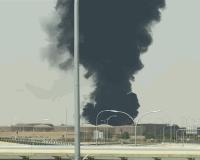
The Saudi General Authority of Civil Aviation identified the two people killed at King Fahd International Airport in Dammam as a Saudi citizen and an Indian resident. The authority did not specify the nature of the attack.
However, the Iran-backed Houthis said on Thursday that Dammam airport was among the locations they had targeted with drones and missiles during the preceding 48 hours.
Two other people were killed on Wednesday morning by debris from a drone intercepted elsewhere in Saudi Arabia’s Eastern Province, the Saudi energy ministry said.
According to the ministry, the drone was intercepted while attempting to target a processing facility owned by Saudi Arabia’s state oil company, Aramco, in the Shaybah oil field. A contractor’s vehicle was set ablaze during the incident. The ministry identified the two people killed as residents from the Philippines and Nepal.
The Houthis’ military spokesman, Yahya Sarea, did not claim responsibility for the attack on the oil field. However, he said the movement had targeted several other locations across Saudi Arabia.
Besides King Fahd International Airport in Dammam, the targets named by Sarea included the Saudi defence ministry’s headquarters building in Riyadh, an Aramco facility in the Red Sea city of Yanbu, and Abha International Airport in the country’s south.
The Saudi-led coalition supporting Yemen’s government in its war against the Houthis said four drones were intercepted over the Eastern Province on Wednesday night. Another four drones were intercepted over the provinces of Riyadh and Medina on Thursday.
Saudi authorities said at least 21 people had been killed in Houthi attacks on Saudi airports since the beginning of October. In the deadliest attack in Saudi Arabia in more than a decade, a missile strike on Riyadh’s international airport on 10 October killed 13 people and injured 308 others.
The Houthis reiterated on Thursday that their attacks on Saudi Arabia were retaliation for deadly Saudi air strikes on territory controlled by the movement in western Yemen.
Houthi-run media reported on Wednesday night that at least six people had been killed and 11 injured in air and artillery strikes during the preceding 24 hours.
According to the Houthi-run health ministry, 155 civilians have been killed since Yemen’s devastating civil war intensified three months ago. The government’s health ministry has reported at least 1,574 deaths in the conflict over the same period. The fighting has also displaced more than 256,000 people.
Yemen’s war began in 2014, when the Houthis ousted the internationally recognised government from the capital, Sanaa. The conflict escalated the following year after a Saudi-led coalition of Arab states intervened in an attempt to restore the government’s rule.
A four-year-old informal ceasefire began to unravel in July, when the Houthis announced a “maritime embargo” against Saudi Arabia and launched missile and drone attacks on Saudi airports, oil facilities and tankers in the Red Sea.
The Houthis said their actions were in retaliation for what they describe as a Saudi blockade of their territory, as well as an air strike on Sanaa airport that they blamed on the kingdom.
The conflict escalated further in September after the Houthis seized part of Yemen’s south-western Red Sea coast near the Bab al-Mandab Strait, a strategic chokepoint for global shipping. Their advance contributed to rising oil prices following six months of war between the United States, Israel and Iran.
Earlier this month, pro-government forces said they had regained control of territory overlooking the Bab al-Mandab Strait after launching a counter-offensive with Saudi air support.
Despite that advance, fierce fighting continues in the area, around the besieged government-controlled city of Taiz, and in the northern provinces of Marib, al-Jawf, Dhale and Shabwa.
The latest attacks on Saudi airports and oil infrastructure, alongside continuing fighting inside Yemen, underscore the widening security risks as the conflict threatens strategic energy facilities, civilian lives and international shipping routes.
About The Author









Comment List