

The election, held on Tuesday, was widely viewed as a referendum on Netanyahu’s leadership, his government’s response to the Hamas-led attacks of October 7, 2023, and Israel’s subsequent genocidal war on Gaza. The vote also took place amid escalating Israeli pogroms in the occupied West Bank and mounting tensions with several neighbouring countries, many of which Israel has attacked over the past three years.
The emerging results have left both major political blocs facing difficulties in securing the 61 seats required to form a government, raising questions about the country’s next administration and the potential role of Arab parties in determining the outcome.
Early Results Point to No Clear Winner
With 76 percent of the votes counted by 11:45 am local time (09:45 GMT) on Wednesday, Netanyahu’s right-wing bloc was projected to win 54 seats, seven short of the majority required to govern, according to election commission figures published by Israeli media.
Eisenkot’s alliance was on course to secure 47 seats, while Arab parties were projected to win 19 seats, building on their performance in the 2022 elections.
Earlier exit polls had indicated a deadlock, projecting that Netanyahu’s and Eisenkot’s respective blocs would each secure 51 seats.
The exit polls suggested that Netanyahu’s Likud party, which leads his wider political bloc, could emerge as the largest single party with an estimated 27 seats. Eisenkot’s Yashar party was projected to win 21 seats, according to Channels 12 and 13.
Israel’s electoral system allows voters to choose political parties, which subsequently form alliances to establish a governing coalition headed by a prime minister. No single party has ever won the 61 seats needed for an outright parliamentary majority.
Exit polls released by Israel’s major television networks are unofficial indicators of voting trends. Preliminary official results were expected on Wednesday, although the final figures could differ from the exit poll projections.
Netanyahu and Eisenkot Make Competing Claims
Opposition bloc leader Gadi Eisenkot said the public had voted for political change and against Netanyahu’s continued leadership.
Addressing supporters at the headquarters of his Yashar party, Eisenkot declared that the country was entering a new political phase.
“This will be a new start. A real new start on a new path. The old era is over, and Israel is starting a new era,” he said.
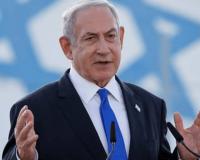
Netanyahu, however, maintained that Likud remained the dominant political force and called for the formation of a “national right-wing government”.
“What we’ve seen is that the Likud party is the largest party – nobody can compete with us,” he said. “The second thing that is clear as well is that the right bloc has a majority, and it is a decisive majority.”
The prime minister also accused Israeli television channels of attempting to discourage his supporters from voting by projecting stronger results for opposition parties.
Far-right Finance Minister Bezalel Smotrich told supporters that his Religious Zionism party was projected to win seven seats. He pledged to continue expanding Israeli settlements in the occupied West Bank, which are illegal under international law.
Far-right National Security Minister Itamar Ben-Gvir also welcomed the projected performance of his Otzma Yehudit party during a speech at its headquarters.
“We are very proud of our journey,” Ben-Gvir said. “This party was not even existing on the political landscape.”
Yair Golan, leader of the Democrats party, wrote on X that voters had “fired the Netanyahu government”. He also pledged to work with political partners to establish a new administration.
Mansour Abbas, leader of Ra’am, or the United Arab List, said he hoped the final results would enable his party and the opposition bloc to reach the 61-seat threshold required to form a government. Ra’am was projected to win approximately seven seats.
Voter Turnout Reaches Highest Level Since 1999
Israel recorded a voter turnout of 77.7 percent, according to the Central Elections Committee, marking the highest participation rate since 1999.
Turnout increased by 7.1 percentage points compared with the 2022 election, when Netanyahu, who has served as prime minister intermittently since 1996, returned to office.
Israel’s military reported that turnout among soldiers had exceeded 68 percent by 5 pm local time (15:00 GMT). More than 60,000 Israelis also returned home from abroad to cast their votes.
Polling stations closed at 10 pm local time (20:00 GMT). However, the official elections body said voters who were still waiting in queues at the time of closure would be allowed to vote.
The turnout figures indicate a substantial level of participation in an election that has placed Netanyahu’s leadership and the future direction of Israeli politics at the centre of the contest.
Arab Parties Emerge as Potential Kingmakers
Exit polls and partial results indicated that Arab-led parties could secure 19 seats, a significant increase from the 10 seats they currently hold in parliament.
The projections also showed Netanyahu’s and Eisenkot’s blocs tied at 51 seats each in the earlier exit polls, before preliminary official results began emerging.
With 61 seats required to form a government, neither leading bloc appeared capable of securing a parliamentary majority without additional support, making Arab parties potentially decisive in the coalition negotiations.
Both Netanyahu and Eisenkot have previously refused to form governing coalitions with Arab parties. Netanyahu described the prospect of working with Arab leaders as a “disgrace and a shame”.
Alon Pinkas, a former Israeli ambassador, told Al Jazeera that forming a government could prove difficult for both political camps because of their commitments not to enter such a coalition.
“There’s a price to pay,” Pinkas said, arguing that “Arabs can’t be kept outside and only being considered and co-opted when you need their votes”.
The projected increase in Arab representation could therefore become a crucial factor in determining whether either bloc can assemble the support required to govern.
What Happens Next in Israel’s Government Formation Process?
Once the vote count is finalised, political parties are expected to begin negotiations immediately to secure the 61 seats needed to form a government.
The bloc with the most votes will have several options for assembling a majority, including seeking support from smaller parties, forming a minority government or reaching a power-sharing arrangement with another political leader under which the two leaders alternate as prime minister.
After the final count, Israeli President Isaac Herzog will consult party leaders about their preferred candidate for prime minister. Herzog will then nominate the candidate he believes has the strongest chance of forming a government.
The nominee will have up to 42 days to complete the government formation process.
A merger between the two leading political camps remains another possible scenario, but Pinkas said voters would “never forgive” Eisenkot if he joined Netanyahu’s bloc. He also warned that an arrangement involving rotating prime ministers would guarantee “dysfunction”.
If the negotiations do not produce a new government, Netanyahu and his current cabinet will continue in office as a caretaker government.
Should coalition talks fail and no government be formed, Israel will hold fresh elections.
The final vote tally is expected by Friday, while the official election results are scheduled to be formally published on November 4, a week after the election. Until then, the outcome of coalition negotiations and the position taken by Arab parties are likely to remain central to determining Israel’s political future.
About The Author








Comment List