

In the era preceding modern recording, television cameras documented him much later than the public consciousness did. Long before the broadcasts, fans were intimately familiar with his name. Journalists would station themselves outside his school, and cricket connoisseurs would travel from distant states to Mumbai specifically to witness a child bat. In the mid-1980s, trust in a player’s caliber did not require video evidence. Unlike today, where every run, shot, and record must be visually verified through mobile applications and live streaming, that era relied on a singular, powerful narrative that resonated across the country: "There is a boy." From the public playing fields of Mumbai to the Cricket Club of India, and from newsrooms to local tea stalls, this phrase echoed without the aid of the internet or fiber-optic networks. Through newspaper headlines, radio commentary, and oral testimonies, people constructed a vivid image of a phenomenal batsman in their minds. To those who did not witness that period, it remains difficult to conceptualize how the Indian cricket community fell in love with a player most had never actually seen play.
Mumbai served as the birthplace of this unprecedented credibility. When senior journalists from across India are asked when they first heard of Tendulkar, their answers converge not on the Pakistan tour or famous interviews, but on the local circuits of Mumbai. Senior journalist Rajdeep Sardesai recalls hearing the name when the athlete was a mere thirteen-year-old schoolboy. A peer at the Cricket Club of India informed him that he had witnessed the "next big star of Indian cricket." It is significant that he was labeled a future legend rather than just a talented youth. Furthermore, despite his age, demands were made to amend the membership rules of the prestigious Cricket Club of India to accommodate him. At that stage, he had played neither first-class nor international cricket, yet the discourse was so profound that elite institutions considered systemic changes. This reflected not only his individual brilliance but also the immense institutional weight of Mumbai’s cricket culture.
The news traveling from Mumbai resonated throughout the entire nation. Senior cricket journalist R. Kaushik, then a student in Coimbatore, explains that despite being unable to visit the Shardashram Vidyamandir or the Mumbai grounds, the name Tendulkar had reached his city. He notes that during the massive partnership between Tendulkar and Vinod Kambli, Mumbai was the undisputed epicenter of Indian cricket. The journalists and experts there acted as a primary conduit, making it nearly impossible not to hear of the prodigy. This was not the result of a calculated promotional campaign but rather the sheer credibility of the Mumbai cricket network. Therefore, the tour of Pakistan was not Tendulkar’s introduction to India; it was merely the first visual confirmation for television audiences.
In the absence of social media and dedicated news channels, the information still achieved a viral status through newspapers and oral tradition. Fans in the 1980s did not just watch the sport; they read it extensively. Magazines such as Sportstar, Sportsweek, and Cricket Samrat were household staples, and newspapers printed exhaustive scorecards of the domestic Ranji Trophy. Radio commentary extended the reach to betel leaf kiosks and public transport vehicles. Consequently, the public of that era was arguably more informed about domestic cricket than the modern audience. A standout performance would become a headline the following day, then a neighborhood discussion, and eventually a national narrative. The legendary 664-run partnership in the 1988 Harris Shield tournament, where Tendulkar scored an unbeaten 326 and Kambli scored 349 for Shardashram Vidyamandir against St. Xavier’s, remains a landmark. While today such an event would go viral in minutes, then, every run was transmitted through word of mouth, eventually becoming a national sensation that introduced the entire country to Mumbai’s prodigy.
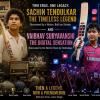
Journalist Vikrant Gupta notes that Mumbai’s status as a central hub allowed former players, selectors, and coaches to foster an environment where a recommendation from a respected expert could permeate the entire cricket fraternity within days. Tendulkar’s ascent was not an overnight miracle but a structured journey from the neighborhood to the city, the state, and finally the nation. His debut in the Ranji Trophy in December 1988 against Gujarat, where he scored a century, served as the ultimate verification of the long-standing rumors. Rajdeep Sardesai, then a young reporter for the Times of India, sought special permission to witness the match at Wankhede Stadium to see if the hype was justified. After witnessing the century, he informed his editor that he had seen the "new sunrise of Indian cricket," leading to his first front-page byline. The Pakistan tour in November 1989 provided the final test of whether a sixteen-year-old could survive international pressures. The iconic images of the Karachi Test and the exhibition match in Peshawar, where he challenged the great leg-spinner Abdul Qadir, solidified his status. Ultimately, while Vaibhav Suryavanshi represents an era of instant digital notification, Sachin Tendulkar represents a time when stars were born from the collective voice of a nation, proving that he was already a household name before the world ever saw his face on a screen.
About The Author



.jpg)






Comment List