

According to official data, several parts of Mumbai recorded rainfall exceeding 200 millimetres in the 24 hours ending at 8 am. The island city registered an average of 195 millimetres, while the western suburbs recorded 208 millimetres and the eastern suburbs 167 millimetres during the same period.
The India Meteorological Department forecast moderate to heavy showers accompanied by thunder and lightning across Mumbai and its suburban regions for the next 24 hours. Earlier, at 4 am, the department issued a red alert for Mumbai and Palghar, warning of thunderstorms, lightning, intense to very intense rainfall, and winds reaching 40 to 60 kilometres per hour. The alert was downgraded to an orange alert at 7 am, indicating continued moderate to intense rainfall across Mumbai, Thane, Raigad, Palghar, and Sindhudurg districts.
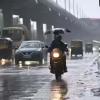
The Brihanmumbai Municipal Corporation reported water accumulation in several key areas, including Andheri subway, Hindmata, and King's Circle, resulting in traffic congestion and restricted vehicular movement across major road networks. Civic officials confirmed that disaster management teams remained on high alert and were actively monitoring rainfall-related incidents across the city.
Suburban railway services were significantly affected as rainwater accumulated on tracks at multiple locations. Although officials confirmed that water levels remained below the threshold requiring suspension of train operations, services were delayed, and commuters experienced severe overcrowding, particularly on Central Railway corridors during peak hours.
The situation escalated on the Central Railway’s Trans-Harbour line between Thane and Vashi and Panvel in Navi Mumbai after a track cave-in occurred between Turbhe and Koparkhairane stations due to excessive water flow. A Central Railway spokesperson stated that the up line was declared unsafe at 5:06 am, followed by the down line at 5:50 am, disrupting morning operations.
Services were gradually restored, with the up line reopened at 7:27 am under a speed restriction of 10 kilometres per hour, while the down line was declared safe at 7:35 am, permitting operations at 30 kilometres per hour. Officials attributed the incident to excessive water flow affecting track stability.
Western Railway operations, however, continued without disruption despite the heavy rainfall across the region.
Tidal conditions further compounded the situation, with a high tide of 3.41 metres recorded at 8:28 am and another high tide of 3.35 metres expected at 7:41 pm, according to the Brihanmumbai Municipal Corporation. Authorities noted that the combination of heavy rainfall and high tide conditions typically contributes to waterlogging in Mumbai, a coastal metropolis surrounded by the Arabian Sea.
Amid the disruption, Shiv Sena Member of Legislative Council Manisha Kayande urged the Mumbai municipal leadership to intensify efforts toward systematic cleaning of stormwater drains and removal of dry waste. She emphasized that such measures were essential to mitigate monsoon-related flooding and traffic disruptions, while also urging that the issue not be politicized.
Kayande stated that inadequate cleaning of drainage systems had contributed to water accumulation in several areas and called for greater administrative efficiency. She added that while some level of waterlogging is expected during heavy rainfall, improved maintenance of drainage infrastructure is essential to reduce public inconvenience.
The southwest monsoon reached Mumbai on Tuesday, arriving 13 days later than its normal onset date of June 10. The India Meteorological Department noted that in 2023, the monsoon arrived even later on June 25, while the longest recorded delays occurred in 1958 and 1974, when the onset was observed on June 28.
Officials confirmed that civic and emergency response teams remain on alert as rainfall activity is expected to continue, with authorities monitoring evolving conditions across the city.
The latest monsoon spell has once again exposed Mumbai’s vulnerability to extreme rainfall events, with transport disruption, infrastructure strain, and civic response capacity coming under sharp focus across the metropolis.
About The Author









Comment List