India’s Neighborhood Strategy Takes Center Stage as Rabi Lamichhane Calls for Enhanced Regional Connectivity

India’s Neighborhood Strategy Takes Center Stage as Rabi Lamichhane Calls for Enhanced Regional Connectivity

Rabi Lamichhane’s article in The Hindustan Times highlights India’s expanding neighbourhood diplomacy under Prime Minister Narendra Modi, focusing on connectivity with Nepal, Bhutan, Myanmar, Sri Lanka, and the Maldives while excluding Pakistan over terrorism concerns and addressing regional geopolitical tensions involving China and Western influence.


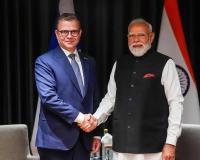
Rabi Lamichhane, founding chairman of Nepal’s ruling Rashtriya Swatantra Party, has authored an opinion piece published exclusively in The Hindustan Times, advocating strengthened cross-border, air, and infrastructure connectivity between India and Nepal. In his article, Lamichhane highlighted the positive trajectory of bilateral relations while cautioning against attempts to escalate border-related tensions, which he attributed to pro-China Communist leaders K P Sharma Oli and Prachanda, alleging that such issues were used to stimulate nationalist sentiment within Nepal.

The article positions India’s regional engagement as a central pillar of its foreign policy. It states that the United States, China, and European countries, including the United Kingdom, are unlikely to reduce what it describes as anti-India influence operations in the Indian subcontinent. Against this backdrop, it asserts that the Narendra Modi government has pursued a strategy of deeper engagement with neighbouring countries, excluding Pakistan, which remains outside diplomatic outreach due to unresolved cross-border terrorism concerns attributed to Rawalpindi.

The piece further notes India’s renewed engagement with Myanmar, including arrangements involving President U Min Aung Hlaing, and suggests that this approach is intended to secure India’s northeastern region from insurgent activity allegedly operating across Manipur, Nagaland, and Arunachal Pradesh.

Since assuming office in 2014, Prime Minister Narendra Modi has consistently promoted closer ties with Nepal, with the article stating his objective of advancing economic integration to ensure Nepal’s development alongside India. It adds that the Ministry of External Affairs has been directed to prioritize neighbourhood diplomacy, emphasizing that India’s global standing is closely linked to stable and robust relations within South Asia.

Read More Cockroach Janta Party Founder to Return from United States to Lead Delhi Protest Over Examination Controversies

On Pakistan, the article reiterates India’s position that engagement will remain suspended until cross-border terrorism is addressed. Regarding China, it notes that India’s bilateral interactions are described as contingent upon peace and tranquility along the 3,488-kilometre Line of Actual Control. It also references concerns raised in the article over China’s inclusion of Jammu and Kashmir in a joint statement during Pakistani Prime Minister Shehbaz Sharif’s visit to Beijing, characterizing this as part of broader geopolitical pressure on India.

Read More India, Australia Move Toward Defence Co-Production with New Agreement Framework

The article further discusses India’s strategic focus on Bhutan, Sri Lanka, and the Maldives, while acknowledging the complex political dynamics in Bangladesh and Nepal due to balancing relations between major global powers. It states that India continues to extend economic assistance to the Maldives despite its leadership coming to power on an anti-India platform, and emphasizes infrastructure cooperation across the region.

Read More Ebola Alert Triggers Fresh Government Advisory as Global Outbreak Raises Concern

It also argues for proactive diplomatic engagement with Nepal, Bhutan, and Myanmar through the appointment of envoys empowered to strengthen bilateral ties. The piece references political developments in Bangladesh, including the removal of Sheikh Hasina, as an example of rapidly changing regional dynamics influenced by external powers.

The article concludes by describing India’s neighbourhood-first approach as a form of informal diplomacy, referred to as “Tea diplomacy,” where regional leaders can engage in direct, flexible dialogue. It asserts that strengthening ties with neighbouring countries remains central to India’s national interest and regional strategy.

Tags:

About The Author

Post Comment

Comment List

Latest News

=Vedanta Under FEMA Scanner as Enforcement Directorate Conducts Searches in Delhi and Mumbai =Vedanta Under FEMA Scanner as Enforcement Directorate Conducts Searches in Delhi and Mumbai
The Enforcement Directorate conducted searches at Vedanta-linked premises in Delhi and Mumbai as part of a FEMA investigation into alleged...
Terence Lewis Opens the Doors to His Luxurious Home as Farah Khan Expresses Admiration
Mumbai Authorities Demolish Alleged Illegal Religious Structure During Anti-Encroachment Drive in Aarey Colony

Live Cricket Score

Advertisement

Science & Tech

 PM Narendra Modi Highlights Civilisational Legacy at Samrat Samprati Museum Inauguration in Gandhinagar PM Narendra Modi Highlights Civilisational Legacy at Samrat Samprati Museum Inauguration in Gandhinagar
Prime Minister Narendra Modi inaugurates the Samrat Samprati Museum in Gandhinagar, highlighting Jain philosophy, India’s civilisational identity, and the role...
Bengal’s Naxalbari Movement: Genesis Of Maoist Menace And Its Enduring Legacy

Health

Coffee-Based Home Remedies Gain Ground as Dermatologists Highlight Natural Skincare Benefits Coffee-Based Home Remedies Gain Ground as Dermatologists Highlight Natural Skincare Benefits
A growing number of dermatologists are endorsing coffee-based home remedies as natural, affordable alternatives to commercial skincare. From face scrubs...
Moringa’s Rise as a Global Superfood Gains Momentum Amid New Research

Lifestyle

 Food Pharmer Sparks Nationwide Debate Over Cheeslings Ingredients, Raises Questions on Food Safety Standards Food Pharmer Sparks Nationwide Debate Over Cheeslings Ingredients, Raises Questions on Food Safety Standards
Food influencer Revant Himatsingka, known as Food Pharmer, has sparked nationwide debate after revealing Cheeslings’ low cheese content and high...
From Gym Floor to City Streets: The Unexpected Revival of the Lopifit Treadmill-Bike
crossorigin="anonymous">