

The situation has raised serious concerns about food security and living standards in the country. For many Iranian families, affording two basic meals a day has become an increasingly difficult challenge.
According to official figures, Iran's inflation rate has reached a record 88.7%. Prices of essential commodities, including milk, cheese, eggs and cooking oil, have surged sharply. The latest figures released by Iran's Statistical Centre show that the average annual inflation rate also climbed to 76.8% in October.
The situation is even more severe in rural areas than in cities. Inflation in rural regions has exceeded 107%, making everyday survival a growing struggle for economically vulnerable families.
Cooking oil has recorded an unprecedented price increase of 255% over the past year. Milk, cheese and eggs have become up to 154% more expensive. Meanwhile, following the removal of subsidies, the price of a packet of bread has increased from 23,800 tomans to 60,000 tomans.
The rising cost of food has also made eating outside increasingly unaffordable. A person ordering a basic meal at an ordinary Iranian restaurant, such as chelow kebab with rice and a cold drink, may have to pay hundreds of thousands or even millions of tomans.
Meat, chicken and other sources of protein have become so expensive that many families have reportedly removed meat from their regular diets. According to Iranian newspaper Ham-Mihan, the declining affordability of chicken and other basic protein sources is increasing the risk of malnutrition.
Even people working long hours in physically demanding jobs are struggling to afford a filling meal. For several families, the cost of arranging two basic meals a day is consuming their entire household budget.
The inflation crisis is unfolding alongside an increasingly serious unemployment problem, adding further pressure to an already struggling population.
Labour Ministry Deputy Minister Malik Hosseini has warned that if Iran's economic downturn continues at the current pace, between 1.2 million and 1.4 million additional jobs could disappear by March 2027.
Figures indicate that approximately 1.15 million people lost their formal employment and insurance coverage between March and August. However, only around 300,000 of them are receiving unemployment benefits.
With employment opportunities shrinking and household incomes under pressure, the ability of ordinary citizens to afford even basic food requirements is becoming increasingly uncertain.
Iran is also facing the prospect of energy shortages as winter approaches. According to National Gas Company official Hooshang Seydali, technical problems at the country's gas processing plants are affecting production by 130 million cubic metres of gas every day.
As a result, 11 provinces could face significant gas restrictions during the winter, particularly North Khorasan, Mazandaran and Golestan.
Factories have already been instructed to use backup fuel. This raises concerns that residents could face difficulties not only in purchasing increasingly expensive food but also in obtaining sufficient gas for cooking and heating during the colder months.
The worsening economic conditions have also intensified political pressure on President Masoud Pezeshkian's government.
In Parliament, lawmakers rejected the arguments presented by Economy Minister Ali Madanizadeh and issued him a formal warning over the economic situation.
The minister acknowledged that workers, pensioners and low-paid employees were bearing the heaviest burden of inflation. However, the government has yet to present a concrete roadmap for overcoming the crisis.
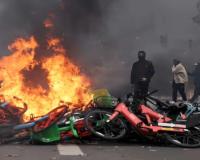
Meanwhile, public anger over rising prices and deteriorating living conditions is increasingly spilling onto the streets. The Iranian administration is reportedly deploying security forces to contain public unrest.
In Shiraz, teachers and trade union activists are being arrested and sent to prison. Protesters who were injured during the 2022 demonstrations are also being detained again.
Reports of gunfire targeting a police facility and protests have also emerged from Kash, in southeastern Iran.
With inflation eroding purchasing power, unemployment threatening millions of livelihoods and energy shortages adding to the uncertainty ahead of winter, Iran is facing mounting economic and social pressure.
For ordinary citizens, the struggle is increasingly centred on securing basic necessities, particularly food. The combination of rising living costs, shrinking employment opportunities and restrictions on public protests has raised questions about whether the country is heading towards another major wave of public demonstrations.
About The Author









Comment List