

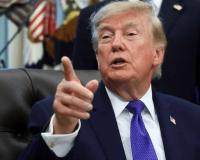
“We may do another little Epic Fury, or they'll agree. If they're smart, they'll just say, let's get down to business,” Trump said during a Republican campaign rally in Florida.
However, Trump did not specify the conditions Iran would need to meet to prevent another round of military action.
Operation Epic Fury was a joint military campaign launched by the United States and Israel against Iran in February, triggering the months-long ongoing war. The attack resulted in the death of Iran's former Supreme Leader Ayatollah Ali Khamenei and his family members.
During his address, Trump also referred to an earlier military operation against Iran, Operation Midnight Hammer, claiming that it had destroyed the country's nuclear enrichment capabilities and significantly weakened its military and economy.
“We obliterated Iran's nuclear enrichment capacity with Operation Midnight Hammer...We defeated them militarily, financially and otherwise, and now we are ensuring it's done,” he said.
Trump's remarks came hours after a US envoy suggested that American forces could strike Iran as soon as the weekend.
“Could there be a strike this weekend? Absolutely. President Trump is very clear. He's open and available and accessible to a deal, and we've been at the table for months and months and months,” Tom Barrack, the US ambassador to Turkey and point man on Syria, said during a podcast with Mario Nawfal. Barrack does not have a direct role in Iran.
Trump briefly downplayed the envoy's remarks, responding, “That was my ambassador? He's a pretty powerful man, I guess. If that's the case, I don't know anything about it.”
Trump also indicated that he expected the war with Iran to end soon, although he did not provide a specific timeline or clarify whether negotiations were currently underway.
“I see it ending one way or another, through agreement or otherwise,” he told a local Florida media outlet.
The US President maintained that preventing Iran from acquiring nuclear weapons remained the overriding objective of American military operations. He also argued that previous administrations had failed to address the threat posed by Iran's nuclear ambitions.
“I had to attack Iran, or they would have had a nuclear weapon,” he said.
Meanwhile, Iran has issued a warning to the United States against launching further attacks, threatening potential retaliation against undersea communications cables in the Gulf if Washington and Israel resume military action.
According to a Reuters report, an Iranian official said the country had drawn up detailed plans to target undersea communications cables and would seek to prevent repairs following any attacks, potentially prolonging disruptions to communications, including internet connections.
“If Iran is attacked, there will be no more red lines...from undersea cables to military bases, including covert ones. US should not play with fire,” the official said.
The warning raises concerns about potential disruptions to critical communications infrastructure if the conflict escalates further.
Separately, US intelligence has warned that Iran has intensified efforts to target American officials, with some alleged lethal plots reportedly reaching an advanced stage. The warning came as Washington withdrew diplomats from Saudi Arabia and reduced staffing at several other US embassies across the region.
According to Axios, Director of National Intelligence Jay Clayton warned Secretary of State Marco Rubio in a one-page, unclassified memo dated October 23.
However, the memo did not identify any potential targets, specify countries outside the Middle East, or provide details about the nature of the alleged plots.
Earlier this week, the United States ordered non-emergency staff to leave the US Embassy in Riyadh and the consulates in Jeddah and Dhahran. Staff reductions were subsequently implemented at US embassies in the UAE, Lebanon, Qatar and Jordan.
Diplomats described the process as “chaotic”.
With Trump threatening renewed military action, Iran warning of retaliation against critical infrastructure and US intelligence raising concerns about potential threats to American officials, the situation remains volatile. The possibility of further strikes, alongside the absence of a clear timeline for ending the war, leaves the prospect of a negotiated settlement uncertain.
About The Author









Comment List