

The Bharatiya Janata Party is currently leading across all four assembly constituencies in the Jhargram district, including Nayagram, Gopiballavpur, Jhargram, and Binpur. The region, part of the Junglemahal belt, has long been considered economically underdeveloped, with Scheduled Castes and Scheduled Tribes together forming nearly half of the population. Voting patterns in this area are often decisive, and current trends indicate a shift in favour of the Bharatiya Janata Party.
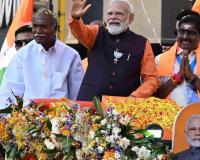
During his campaign visit in April, Prime Minister Narendra Modi made an unscheduled stop at a roadside stall in Jhargram. He asked the vendor, “Brother, serve us your spiced puffed rice snack,” and ordered a small portion of ten servings. He also insisted on paying for it himself.
The interaction quickly went viral due to its spontaneity and the Prime Minister’s light-hearted exchange. When asked about onions, he responded, “Yes, I eat onions, not brains.” The remark was widely circulated on social media, drawing both appreciation and criticism.
Supporters viewed the moment as a relatable gesture highlighting the Prime Minister’s connection with everyday life. However, the Trinamool Congress dismissed it as a staged photo opportunity and pointed out that the stall was constructed under a state government initiative.
The spiced puffed rice snack, widely consumed across Bengal, holds strong cultural familiarity and is closely associated with everyday street food traditions. The Prime Minister’s stop was interpreted by observers as a symbolic attempt to challenge the long-standing outsider-versus-insider narrative in West Bengal politics.
The Bharatiya Janata Party has frequently been labelled as outsiders by the Trinamool Congress. By engaging with a local food symbol, the party appeared to position itself as more aligned with regional identity and cultural familiarity. This symbolic approach appears to have resonated, particularly in Jhargram.
Jhargram is one of the 294 assembly constituencies in West Bengal and is classified as semi-urban. The contest in the region has primarily been a direct battle between the Bharatiya Janata Party candidate Laxmikant Sahu and Trinamool Congress candidate Mongal Saren.
Early trends indicate that the Bharatiya Janata Party has taken the lead in the constituency, reflecting its broader performance across the district. If sustained, this would mark a notable breakthrough for the party in a region where electoral outcomes are strongly influenced by local concerns and identity-based politics.
The broader political implication of the so-called “snack moment” extends beyond symbolism. Modern electoral communication increasingly relies on small, culturally resonant gestures alongside traditional campaigning. In Jhargram, this approach appears to have contributed to a visible shift in voter preference.
As counting trends continue to develop, the situation in Jhargram suggests that even brief and seemingly minor campaign interactions can carry significant political weight in shaping electoral narratives.
About The Author








Comment List