

However, Gurugram now stands at a critical inflection point where the very forces that propelled its rise are placing increasing pressure on its urban systems. Traffic congestion, rising density stress, and widening infrastructure gaps are becoming central concerns, shifting the conversation from expansion alone to long-term urban sustainability and liveability.
Despite these challenges, Gurugram’s real estate market continues to demonstrate strong underlying demand fundamentals. Recent market data indicates that the Delhi-NCR region recorded nearly 15 to 16 million square feet of office leasing activity in 2025, with Gurugram accounting for a dominant share. This growth has been driven by global capability centres, technology firms, and financial institutions that continue to anchor corporate demand in the city. Residential demand has also remained resilient, particularly within premium and upper mid-income segments.
The city’s continued attractiveness is supported by structural advantages, including its proximity to Delhi and the Indira Gandhi International Airport, a strong corporate ecosystem, expanding infrastructure corridors, a high-income demographic base, and sustained institutional investor confidence. Unlike speculative markets, Gurugram’s growth remains closely tied to employment generation, providing the market with long-term stability and depth.
A clear shift in the city’s spatial development pattern is also underway, as Gurugram expands beyond its traditional core. Earlier development concentrated around Golf Course Road, Cyber City, and MG Road, but current momentum has moved toward emerging corridors such as the Dwarka Expressway, New Gurugram, Southern Peripheral Road, and developing sectors along the city’s outskirts. This expansion reflects a strategic redistribution of urban density and the creation of new residential and commercial clusters beyond already saturated zones.
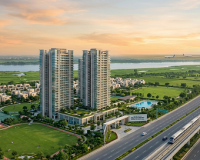
In these emerging corridors, projects such as MRG Crown in Sector 106 along the Dwarka Expressway highlight the growing demand for integrated residential ecosystems that balance connectivity with improved liveability. These locations are increasingly preferred by end-users seeking long-term value, better planning, and lower-density environments supported by improved road infrastructure.
At the same time, Gurugram’s infrastructure limitations are becoming more visible. Key arterial routes, including National Highway 48, Golf Course Extension Road, and Sohna Road, continue to experience severe congestion during peak hours. Issues such as waterlogging, pressure on civic utilities, and uneven infrastructure development persist across several parts of the city.
The central challenge lies not only in the speed of development but also in the widening gap between real estate density and infrastructure readiness. For years, urban growth in Gurugram has outpaced planning frameworks, a model that is becoming increasingly unsustainable as the city matures.
The next phase of development is expected to prioritise integrated and infrastructure-led planning. Future growth corridors will need to evolve in parallel with transport networks, drainage systems, utility infrastructure, and social amenities, rather than following real estate development. Mixed-use development is also expected to gain prominence, reducing commuting pressures by combining residential, commercial, and lifestyle infrastructure within unified ecosystems. Additionally, evolving buyer expectations are placing greater emphasis on open spaces, lower density, community infrastructure, and enhanced lifestyle amenities.
This transition signals a gradual shift in demand dynamics from purely investment-driven activity toward stronger end-user-led absorption. Gurugram is therefore entering a more mature phase of its urban evolution, where rapid expansion alone is no longer sufficient to sustain long-term growth.
The city’s economic fundamentals remain robust, supported by continued corporate expansion, sustained infrastructure investment, and healthy residential absorption. However, maintaining this momentum will require a more disciplined and balanced approach to urbanisation.
The coming decade is expected to mark a decisive shift from rapid construction-led growth to integrated urban development, where infrastructure, mobility, and liveability progress in tandem. Gurugram’s growth story remains far from complete, but its next chapter will be defined not by scale alone, but by sustainability, planning discipline, and urban resilience.
About The Author









Comment List