

In 79 years, India has progressed from basic communication systems to satellites, supercomputers and indigenous AI models. From Chandrayaan and Digital India to the Jan Dhan-Aadhaar-Mobile (JAM) Trinity, technology has accelerated the economy while fundamentally changing the daily lives of ordinary citizens.
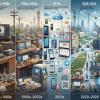
When India became independent in 1947, technology was largely limited to radio, telephones and a small number of industrial tools. Today, the country has entered the era of smartphones, 5G, UPI, digital services, artificial intelligence and robotics. Over nearly eight decades, India has travelled a long distance in technology, with its early technological development focused more on nation-building than consumer gadgets.
At the time of Independence, communication facilities in India were extremely limited. Radio was a major medium for delivering news and entertainment, while telephone services remained beyond the reach of most people. The focus of technological development was on building self-reliance and strengthening electricity, industry, agriculture and scientific institutions.
During the 1960s and 1970s, television began reaching Indian households. Doordarshan played an important role in connecting different parts of the country through information and entertainment. India also strengthened its foundations in space and scientific research during this period. Computer technology gradually entered institutions and large organisations, moving from being primarily associated with scientific laboratories towards becoming part of everyday life.
In the 1980s, computers began entering Indian offices, while changes also emerged in the telecommunications sector. Computers were not yet devices carried by individuals like smartphones today, but the period created a strong foundation for India’s IT sector. It was also the period when India increasingly recognised that Information Technology could transform the national economy.
The 1991 economic reforms brought a major change to India’s economy. The reforms opened the way for foreign companies and new technologies, accelerating the Telecom and IT sectors. Mobile phones began appearing in India, although they were extremely expensive in the initial years. Internet services also gradually entered the country. Internet speeds were extremely low compared with today, but the technology prepared India for the coming Digital Revolution.
As the new century began, Internet usage expanded rapidly. Cyber Cafes, Email, Online Banking and Search Engines became part of people’s lives. Mobile phones then transformed communication. Instead of waiting for access to a Landline to contact someone, people gained the ability to communicate from almost anywhere.
The arrival of Smartphones brought another major shift. Mobile phones evolved from communication devices into Cameras, Computers, Entertainment Devices and gateways to the Internet.
After 2010, Smartphone and Mobile Internet adoption increased rapidly in India. Social Media, Online Shopping, Digital Banking and the App Economy changed everyday life. Programmes such as Digital India focused on strengthening connectivity between citizens and digital services. Digital technology expanded across education, healthcare, government services and business.
During the same period, India’s Digital Public Infrastructure gained a new identity. Services that previously required people to visit government offices could increasingly be accessed through mobile phones.
In the 2020s, Digital Technology became an integral part of everyday life in India. Smartphone payments, Online Classes, Work From Home, Video Calling and OTT entertainment became normal. The arrival of 5G opened new opportunities for High-Speed Connectivity, while Artificial Intelligence, Cloud Computing, Internet of Things and Automation also gained momentum.
Technology was no longer limited to major cities. Mobile Internet and digital services expanded into smaller cities and rural areas. According to the 2025 government address cited in the source, nearly all villages had 4G mobile connectivity, while digital payments had expanded on a large scale.
If the 2000s can be described as the Internet Revolution and the 2010s as the Smartphone Revolution, the 2020s can be seen as the era of the AI Revolution. Artificial Intelligence is now being used in Content Writing, Translation, Image Generation, Voice Technology, Data Analysis, Education, Healthcare, Agriculture and Business.
The Indian government has also launched the IndiaAI Mission, aimed at strengthening AI computing, datasets, indigenous AI capabilities, talent, startups and a responsible AI ecosystem. According to information provided on India.gov.in, work in 2026 is progressing towards developing an AI computing ecosystem with a capacity of more than 10,000 GPUs under IndiaAI.
Technology in India is therefore no longer limited to Smartphones or the Internet. The focus has shifted towards how AI can be used to solve the problems of the next generation faster and more effectively.
The transformation is not limited to devices. The way people work, study, shop, transfer money, travel and communicate has changed. There was a time when owning a radio at home was considered a sign of modernity. Television followed, then computers, the Internet and mobile phones. Today, a single Smartphone can contain a camera, bank, television, newspaper, books, GPS and thousands of applications, while AI is making these capabilities increasingly intelligent.
According to India.gov.in, India’s Technology Journey is far from over. In 2026, Artificial Intelligence, Robotics, Quantum Computing, Semiconductors, 5G/6G and Advanced Automation are pointing towards the next major technological leap. The IndiaAI Mission also seeks to build a strong ecosystem for AI innovation and responsible AI adoption.
The journey that began with radio has now reached Artificial Intelligence. As India marks its 80th Independence Day in 2026, the country’s technological transformation reflects 79 years of change from basic communication systems to advanced digital and AI capabilities, while the next chapter of India’s technology story remains ahead.
About The Author

.jpg)
.jpg)
.jpg)
.jpg)

.jpg)



Comment List