

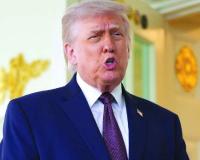
Trump described Modi as a long-time friend and a skilled trade negotiator, remarking that he “may look like an angel, but actually, he’s as tough as a killer.” In contrast, Prime Minister Modi maintained a restrained and formal tone, relying largely on prepared remarks after the bilateral meeting. He described the discussions as productive and thanked Trump for his role in helping restore peace in the Middle East, without repeating his earlier practice of publicly calling the US president a friend.
The exchange reflected a more cautious approach from New Delhi as both nations attempt to recalibrate ties after more than a year of friction involving tariffs, Russian oil imports, Pakistan, and the Iran conflict. Analysts noted that despite cordial gestures, significant disagreements continue to impede a full reset in relations.
Milan Vaishnav, Director of the South Asia Program at the Carnegie Endowment for International Peace in Washington, said the past eighteen months have served as a warning for India regarding overdependence on the United States. He stated that India is likely to remain engaged with Washington while simultaneously diversifying its global partnerships.
During the G7 visit in France, India intensified engagement with other middle-power nations, including Canada and the United Kingdom. The United Kingdom announced that its 4.8 billion pound, or 6.4 billion US dollar, trade agreement with India will come into force on July 15, while agreements with Canada and the European Union are expected later in the year.
Although India was among the first countries to begin trade negotiations with the United States following Trump’s return to the White House, a final agreement remains unresolved. Trump stated that both sides were very close to a deal, but analysts expressed skepticism. Michael Kugelman, Senior Fellow for South Asia at the Atlantic Council, noted that repeated claims of an imminent agreement have not yet materialized, indicating persistent obstacles in negotiations.
US Trade Representative Jamieson Greer is expected to visit India next week to advance discussions. However, Indian officials maintain that progress on a final deal is unlikely until the conclusion of two Section 301 trade investigations that Washington is conducting, which could pave the way for additional tariffs.
Tensions have also deepened due to Washington’s renewed engagement with Pakistan. Trump has repeatedly claimed credit for helping bring an end to brief four-day military clashes between India and Pakistan last year, a claim firmly rejected by New Delhi. Pakistan, however, has welcomed Trump’s assertions and strengthened its engagement with the United States, particularly through Army Chief Asim Munir, in efforts related to regional diplomacy involving Iran.
Kugelman observed that these developments, combined with other unresolved disputes, have prevented a genuine reset in bilateral relations.
Additional strain emerged following a United States strike on three Indian-crewed vessels in the Gulf of Oman, which resulted in the deaths of at least three sailors. New Delhi strongly criticized the incident, as the ships were targeted during a US blockade of vessels linked to Iranian ports. Prime Minister Modi raised concerns over the safety of Indian seafarers during his meeting with Trump, while the US president avoided directly addressing questions regarding regret over the fatalities.
Further uncertainty was introduced by the Pentagon’s decision to rename the Indo-Pacific Command as the United States Pacific Command, reversing a previous designation introduced during Trump’s first term. Analysts interpreted the change as a potential shift in Washington’s regional outlook, noting that the earlier inclusion of “Indo” symbolized India’s strategic importance in balancing China.
Another major point of contention remains India’s continued purchase of Russian oil. Trump had earlier imposed a 50 percent tariff on Indian exports to the United States, partly aimed at discouraging these imports. During the Iran conflict, temporary waivers had allowed Indian refiners to resume Russian oil purchases, but with the situation stabilizing and waivers not renewed, uncertainty persists over future energy trade dynamics.
Despite these challenges, the United States continues to be a critical partner for India in trade, technology, and defense cooperation. Vivek Mishra, Deputy Director of the Strategic Studies Program at the Observer Research Foundation, noted that decades of strategic investment in the relationship make a complete breakdown unlikely. He added that while personal rapport between leaders may influence tone, the broader stakes of the partnership remain substantial.
The evolving interaction between Washington and New Delhi underscores a relationship marked by strategic necessity, persistent disagreements, and cautious diplomacy, as both sides attempt to balance cooperation with competing geopolitical interests.
About The Author

.jpg)

.jpg)




Comment List