

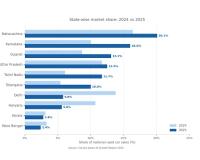
According to Anarock, premium and luxury homes now account for a significantly higher share of new residential launches in several Tier 2 cities, showcasing developer confidence in sustained end-user demand. The contours of wealth creation are shifting as enterprise-led growth overtakes traditional accumulation, with family-run businesses scaling and industrial clusters deepening their influence. A defining aspect of this transition is the dominance of the end user, led by business families upgrading primary homes, next-generation buyers raising lifestyle benchmarks, and NRIs returning with global exposure and local ties. Unlike metros, where luxury aligns with investment logic and second homes, demand here is rooted in high-conviction homeownership, centered on creating residences that serve as lifestyle upgrades and long-term legacy assets.
Umang Jindal, CEO of Homeland Group, noted that in markets like Mohali and Chandigarh, luxury is being defined by deeply rooted local wealth rather than external capital, as entrepreneurs and professionals choose to elevate their living standards without relocating. Jindal emphasized that buyers are not experimenting with luxury but committing to it, translating into preferences for expansive layouts, gated villa communities, and low-density developments that offer privacy and permanence. Similarly, Preksha Singh, CEO of Agrasheel Infratech, stated that in cities like Lucknow, the premium market is evolving organically as a design-aware generation seeks refinement and a "sense of arrival" within their own city. Singh highlighted a strong emotional dimension where families build legacy homes rather than migrate, creating stable, anchored demand.
Ashwinder R. Singh, Chairman of the CII Real Estate Committee, Vice Chairman of BCD Group, and Advisor to NAR-India, described this not as a shift of luxury, but a shift of confidence where homebuyers choose to upgrade where they live rather than migrate. Singh remarked that Tier 2 cities are developing their own consumption identity defined by intent rather than price, with native aspiration powered by infrastructure and digital exposure making this a credibility test for developers where trust travels faster than brand. Land is also emerging as a key component of this growth, particularly in peripheral pockets where price appreciation is tangible. Developers are recognizing land as a play on future growth, with demand rooted in local ambition that infrastructure merely brings to the surface.
Kushagr Ansal, Director of Ansal Housing, observed that the shift toward luxury housing is part of a broader structural evolution moving away from speculative cycles toward consumption-led growth where buyers invest in homes to hold over generations. In North India, Harvinder Singh Sikka, Chairman of Sikka Group, identified Dehradun as a unique intersection of natural appeal and urban aspiration where buyers seek lifestyles blending wellness and exclusivity. This has led to a preference for boutique luxury developments and villa formats among business families and returning professionals, signaling that luxury is being internalized. Ultimately, what is unfolding across Tier 2 cities is a fundamental rebalancing of India’s housing narrative, where luxury housing is becoming evenly anchored and shaped by the unique economic and cultural momentum of multiple cities.
About The Author









Comment List