

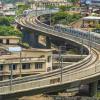
In response to this persistent urban paralysis, Bengaluru took a decisive leap toward reimagining its transport infrastructure. The Bangalore Metro Rail Corporation Limited (BMRCL), in collaboration with Afcons Infrastructure Ltd., designed and executed South India’s first road-cum-rail double-decker structure. This innovative system allows road traffic to move on one level while metro trains operate above on a separate elevated tier.
The construction phase itself was an engineering challenge of exceptional scale. Due to heavy daytime traffic and spatial constraints created by existing flyovers and metro infrastructure, all construction activity was restricted to a narrow window between midnight and 5 AM. Over time, workers built one of India’s most complex urban transport structures, one night at a time, in near darkness.
The project comprises five interconnected flyovers designated A, B, C, D, and E, extending across a total length of 3.2 kilometres along the Outer Ring Road and Central Silk Board Junction. Each flyover has been engineered to manage specific directional traffic flows, functioning collectively as an integrated system designed to eliminate congestion at the junction.
Among these structures, Flyover D stands as the tallest at 28 metres, equivalent to approximately a nine-storey building. It rises through multiple infrastructure layers, crossing the existing Hosur flyover, the Yellow Line metro infrastructure, and the double-decker system, creating a multi-tiered transport corridor suspended above active urban movement.
A defining feature of the project is its integration with Bengaluru’s metro network. The Blue Line metro, part of the Namma Metro system, runs elevated along this corridor. As part of Phase 2A of the Silk Board–KR Puram stretch, Afcons Infrastructure Ltd. constructed a 9.8-kilometre elevated metro section positioned above the road flyover system, marking an unprecedented engineering configuration in South India.
The transformation has been implemented in phases. Flyovers A, B, and C were opened in mid-2024, enabling commuters travelling between BTM Layout, Ragigudga, HSR Layout, and Electronic City to bypass the Silk Board signal entirely. In April 2026, Flyovers D and E were inaugurated, completing the corridor and allowing uninterrupted movement between HSR Layout and BTM Layout without entering the junction.
The impact on daily commuting has been significant. The redesigned corridor now saves commuters at least 30 minutes per trip through this route. Multiplied across hundreds of thousands of daily users, the reduction represents a major shift in urban mobility efficiency. Silk Board Junction, once synonymous with chronic congestion and commuter frustration, has now emerged as a landmark example of large-scale urban infrastructure transformation in India.
About The Author










Comment List