

Consider the situation in 2022. Following Russia's full-scale invasion of Ukraine, President Vladimir Putin found himself increasingly isolated on the international stage. Western leaders were determined to boycott Putin and Russia over the war in Ukraine.
By 2026, however, Putin has managed to secure a historic meeting in Shenzhen. For the first time in history, the leaders of China, Russia and the United States will sit together for a meeting involving only the three countries. This will put Putin exactly where he wants to be: at the centre of the world's biggest political table, alongside the leaders of two major global powers.
The meeting will give Putin an opportunity to claim that Western pressure on Russia has failed.
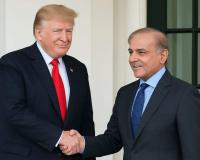
On November 18, 2026, before the welcome reception for the Asia-Pacific Economic Cooperation (APEC) Summit in Shenzhen, China, US President Donald Trump (left) shook hands with Russian President Vladimir Putin, while Chinese President Xi Jinping was also present.
Speaking at an APEC business forum, Putin said, "There have been unsuccessful attempts to isolate Russia. Sanctions pressure has been imposed on Russia on a scale never seen before."
He subsequently met Chinese President Xi Jinping. However, Russia says the biggest event in Shenzhen will be the trilateral meeting involving Putin, Xi Jinping and Donald Trump.
The meeting will give Putin an opportunity to project himself as a global leader, even as Russian forces continue attacking towns and cities across Ukraine and the Kremlin rejects the idea of a comprehensive ceasefire without preconditions.
A brief meeting is unlikely to change the global political landscape. However, the way the meeting is perceived could be far more significant. The photograph, the photo opportunity, three leaders representing three major powers and discussions on important global issues will all contribute to its political significance.
In a way, Vladimir Putin will use the meeting to send the world a holiday postcard. Instead of writing, "Wish you were here," his message will effectively be, "Look, I am here."
But what about those who have not been invited to the meeting?
European leaders, particularly those in Ukraine, are concerned that the gathering of the three leaders may not remain limited to a symbolic photograph. They fear it could also lead to decisions that may not serve Ukraine's interests.
Donald Trump has already said that he wants to discuss his "favourite issue" — the war in Ukraine — during his visit to Shenzhen. The Kremlin may see this as an opportunity to present its position directly to Trump and Xi Jinping without Ukrainian officials or European leaders being present.
Last month, Ukrainian President Volodymyr Zelensky expressed concern that the meeting between Putin, Trump and Xi could resemble the 1945 Yalta Conference.
At that conference, the leaders of the Soviet Union, Britain and the United States — Joseph Stalin, Winston Churchill and Franklin D. Roosevelt — met to determine Europe's new political order following World War II.
Zelensky said, "We absolutely do not want this meeting to become 'Yalta 2, 3, 4' and lead to another division of spheres of influence in the world."
It remains unclear whether China wants the Ukraine war to be included in the discussions in Shenzhen. Official Chinese statements on the upcoming trilateral meeting have generally emphasised the need to "maintain world peace and promote strategic stability" rather than focusing on the Ukraine conflict.
Russia will seek to make the most of the photograph and the message emerging from the Shenzhen meeting. However, a diplomatic victory is not the same as a military victory.
Nearly five years after President Putin launched what he calls a "special military operation", Russia is still struggling to win the war against Ukraine. During this period, Russian forces have suffered heavy losses on the battlefield.
Just ahead of the summit, Ukraine attacked the bridge connecting Russia with the Crimean Peninsula. The attack dealt a blow to Russia's prestige. Moscow had spent billions of dollars building the bridge after seizing Crimea from Ukraine. A section of the bridge was severely damaged in the attack.
The damage is not merely a transportation problem for Russian officials. It also serves as a reminder that the Kremlin's so-called "special military operation" has not unfolded according to its original plans.
The Shenzhen meeting will undoubtedly give Vladimir Putin a prominent global platform and attract international attention. However, securing a place alongside the leaders of the world's two other major powers does not necessarily mean that Russia is any closer to winning the war in Ukraine.
About The Author






Comment List