

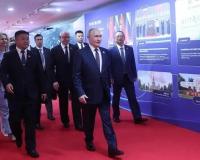
Political commentators often describe such impressions as "optics". Some have characterised the meeting as a historic "Yalta 2.0" gathering of the world's major powers.
The grandeur and elaborate arrangements may have been precisely what the US president wanted most. Earlier this month, his Republican Party suffered a crushing defeat in the midterm elections, making the opportunity to command global attention during a three-day visit to Asia particularly significant. Trump appeared to relish the international spotlight and the historic importance of the first trilateral meeting involving the United States, Russia and China.
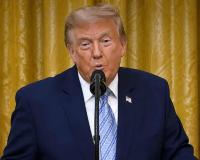
In an interview with Fox News on Wednesday, Trump highlighted his prominent position at the APEC dinner and the grand reception he received upon arriving in China.
He said the "grand welcome, the beauty, the incredible event and thousands of people" were proof that his visit had already been a success.
However, the United States has so far issued remarkably few statements following the trilateral meeting.
China promptly released a joint statement detailing the discussions, while Putin spoke at length during a one-hour press conference after the meeting.
Trump, by contrast, has made very few public comments. Instead, he has promised to hold a press conference at the White House on Friday.
During his visit to China earlier this year, as well as after meeting Xi Jinping at the APEC summit in South Korea last October, Trump had spoken to the media aboard his aircraft while returning to Washington.
For now, the White House is responding to the meeting through the joint statement released on Thursday, following the discussions between the three leaders.
However, the document largely offers vague support for efforts to ensure "strategic stability and international security".
Photographs of three powerful leaders sitting together in the same room and discussing global issues in a cordial atmosphere may offer some reassurance that a devastating conflict is unlikely in the near future.
But beyond pledges to continue "dialogue" and an acknowledgment that nuclear war "must never be fought", the statement contains very little concrete substance.
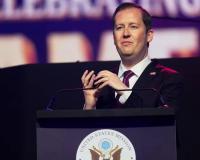
David Firestein, head of the Bush Foundation, which works on US-China relations, told the BBC: "On balance, it's a good thing when leaders of the world's major powers come together in different ways, even if the results appear very modest."
The reference to promoting the "production and supply of refined petroleum products" may have been directed particularly at Putin, given that Russian oil and gas are major sources in the international market.
The condemnation of the International Criminal Court (ICC) was also difficult to overlook. In recent times, the ICC has become a target of American discontent.
If the leaders of the world's three major powers can agree on one issue, it appears to be that multilateral international organisations seeking to enforce international law should not have sufficient authority to advance their efforts.
While in China, Trump described Putin as his "friend". After shaking hands and embracing Chinese leader Xi Jinping, he also praised his "excellent personal relationship" with Xi.
However, upon returning to Washington, Trump may face a political environment marked by mixed reactions to his Asia tour, ranging from limited concern to outright criticism.
Republican Senator John Curtis of Utah told the BBC on Thursday that he was concerned about how the United States was presenting its relationships with geopolitical adversaries.
"I'm concerned about how we're portraying our relationships with geopolitical adversaries. Vladimir Putin and Xi Jinping are not our friends," he said.
He added: "Diplomacy is important, but it should not come at the cost of losing clarity about who our adversaries are."
The contrasting responses to Trump's Asia visit highlight the gap between the diplomatic spectacle of the trilateral summit and the limited concrete outcomes reflected in the joint statement. While the meeting brought the leaders of the United States, Russia and China together, questions remain over what was actually achieved beyond the symbolism of their gathering.
About The Author







Comment List