

The figure at the center of the controversy is Eboh Noah Saga, who claims prophetic authority and has drawn national attention for a series of alarming predictions. Saga had earlier declared that the world would be devastated by a catastrophic flood on December 25, 2025, asserting that the warning was divinely revealed to him. According to his claims, God had instructed him to construct large “arks” as sanctuaries for survival, echoing biblical imagery that resonated deeply with many followers.
In the months leading up to the predicted date, Saga reportedly urged his followers to sell their personal property and relocate closer to designated ark sites. Supporters were encouraged to contribute financially toward the construction of these structures, which he presented as humanity’s only refuge from impending destruction. The campaign generated widespread attention, alongside growing skepticism from sections of the public and civil society.
When the prophesied flood failed to materialize, Saga offered an explanation that further fueled controversy. He claimed that divine intervention had postponed the disaster, stating that the flood had been averted or delayed following spiritual appeals. Despite the unfulfilled prediction, he has continued to solicit donations, now claiming that additional arks are required.
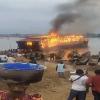
The situation escalated sharply after one of the alleged ark structures was reportedly set ablaze by an individual, reducing it to ruins. While details surrounding the incident remain limited, the act has injected a new level of urgency and tension into an already volatile case. The fire has not only damaged property but has also intensified public debate over the legitimacy of Saga’s activities and the vulnerability of his followers.
The unfolding events have sparked renewed accusations of religious manipulation and possible financial exploitation. Critics argue that the repeated fundraising appeals, especially after the failed prophecy, raise serious red flags about potential fraud. Questions are also being raised about the psychological and economic impact on followers who may have sold assets or uprooted their lives based on the predictions.
In response to the growing outcry, calls are increasing for local authorities to intervene. Community voices and observers are demanding formal investigations into the fundraising practices, the nature of the ark constructions, and whether any laws have been violated. There are also appeals for stronger regulatory oversight to prevent the misuse of religious influence for personal gain.
The case has wider implications beyond the individual involved. It has reignited national conversations in Ghana about accountability among religious leaders, the limits of prophetic claims, and the need to protect citizens from deception carried out in the name of faith.
As pressure mounts for official scrutiny and possible legal action, the Saga episode stands as a stark reminder of how easily belief can be exploited when fear-driven prophecies go unchecked. The coming weeks are likely to determine whether this controversy leads to meaningful accountability or becomes another unresolved chapter in the ongoing debate over faith, power and responsibility.
A controversial religious saga in Ghana has taken a dramatic and troubling turn after a structure linked to a self-styled prophet was deliberately set on fire, reigniting concerns over alleged fraud, false prophecy and the exploitation of religious faith.
The figure at the center of the controversy is Eboh Noah Saga, who claims prophetic authority and has drawn national attention for a series of alarming predictions. Saga had earlier declared that the world would be devastated by a catastrophic flood on December 25, 2025, asserting that the warning was divinely revealed to him. According to his claims, God had instructed him to construct large “arks” as sanctuaries for survival, echoing biblical imagery that resonated deeply with many followers.
In the months leading up to the predicted date, Saga reportedly urged his followers to sell their personal property and relocate closer to designated ark sites. Supporters were encouraged to contribute financially toward the construction of these structures, which he presented as humanity’s only refuge from impending destruction. The campaign generated widespread attention, alongside growing skepticism from sections of the public and civil society.
When the prophesied flood failed to materialize, Saga offered an explanation that further fueled controversy. He claimed that divine intervention had postponed the disaster, stating that the flood had been averted or delayed following spiritual appeals. Despite the unfulfilled prediction, he has continued to solicit donations, now claiming that additional arks are required.
The situation escalated sharply after one of the alleged ark structures was reportedly set ablaze by an individual, reducing it to ruins. While details surrounding the incident remain limited, the act has injected a new level of urgency and tension into an already volatile case. The fire has not only damaged property but has also intensified public debate over the legitimacy of Saga’s activities and the vulnerability of his followers.
The unfolding events have sparked renewed accusations of religious manipulation and possible financial exploitation. Critics argue that the repeated fundraising appeals, especially after the failed prophecy, raise serious red flags about potential fraud. Questions are also being raised about the psychological and economic impact on followers who may have sold assets or uprooted their lives based on the predictions.
In response to the growing outcry, calls are increasing for local authorities to intervene. Community voices and observers are demanding formal investigations into the fundraising practices, the nature of the ark constructions, and whether any laws have been violated. There are also appeals for stronger regulatory oversight to prevent the misuse of religious influence for personal gain.
The case has wider implications beyond the individual involved. It has reignited national conversations in Ghana about accountability among religious leaders, the limits of prophetic claims, and the need to protect citizens from deception carried out in the name of faith.
As pressure mounts for official scrutiny and possible legal action, the Saga episode stands as a stark reminder of how easily belief can be exploited when fear-driven prophecies go unchecked. The coming weeks are likely to determine whether this controversy leads to meaningful accountability or becomes another unresolved chapter in the ongoing debate over faith, power and responsibility.
About The Author




Comment List