

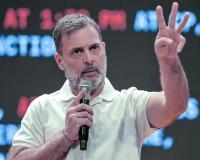
During a conversation at the University of Chicago last week, Rahul Gandhi supported maintaining strong relations with Israel in view of India's strategic interests. At the same time, he condemned Hamas's attacks on civilians in Israel on October 7, 2023, and Israel's subsequent military campaign in Gaza.
His remarks are being viewed as a possible indication of a softening in the Congress party's longstanding position on Israel. Rahul Gandhi had also supported the Modi government's approach to the Russia-Ukraine conflict.
Rahul shared his comments on Israel during a conversation with University of Chicago Professor Robert Pape on the social media platform X.
The Congress leader said, "India's foreign policy should be determined by what is good for India. I support strong relations with Israel. We have strategic interests, including buying the best weapons for our armed forces."
However, he clarified that this did not mean India should remain silent on Gaza.
"I condemn the October 7 attacks and the killing of innocent people. I also condemn Israel's actions in Gaza. One wrong cannot justify another wrong. India is a country of 1.5 billion people. No country, whether Israel, the United States, Russia or China, should prevent us from playing our rightful role on the global stage. India must stand by its beliefs and principles," he said.
Compared with Rahul Gandhi, Priyanka Gandhi and Sonia Gandhi have been more vocal in opposing Israel's military actions in Gaza. Both have repeatedly described them as genocide.
On Saturday, former Kerala Chief Minister Pinarayi Vijayan launched a sharp attack on Rahul Gandhi, saying his remarks had "exposed the Congress party's clear double standards on the Palestine issue."
Vijayan's party, the CPI(M), is a close ally of the Congress at the national level.
In a post on X, Vijayan wrote, "His pro-imperialist position undermines Nehru's legacy. Nehru's foreign policy stood firmly against imperialism and supported solidarity with the Palestinian struggle."
The Communist Party of India (Marxist-Leninist) also strongly condemned Rahul Gandhi's remarks on Israel.
CPI(ML) General Secretary Dipankar Bhattacharya issued a statement saying, "There can be no independent foreign policy for India that advocates strong strategic relations with Israel. Today, Israel is a genocidal regime. There can be no strategic relationship with a country and regime that continues to carry out the genocide of children, women and ordinary people despite global condemnation."
Dipankar further said, "Just as there could have been no strategic relationship with Nazi Germany or the apartheid regime in South Africa, there should be no room for normalising, supporting or downplaying the seriousness of the genocide taking place in Gaza or Israel's brutal colonial occupation of Palestine."
The controversy has also brought renewed attention to the question of whether Rahul Gandhi's position represents support for the Modi government's foreign policy.
Several experts believe his remarks reflect a broader consensus among India's political elite that, despite differences in political ideology, maintaining relations with Israel is strategically important.
Stanly Johny, international editor of India's leading English-language newspaper The Hindu, wrote on X that Rahul Gandhi's comments on defence relations were factually correct.
"What Rahul Gandhi said about defence ties was actually correct. Israel is an important defence partner for India. Although bilateral trade between the two countries is only $3.7 billion, Israel accounts for around 15 per cent of India's defence supplies. Between 2021 and 2025, it was India's third-largest defence supplier, while Russia accounted for 40 per cent and France for 29 per cent," he wrote.
Johny said the shift in India's defence relationship with Israel did not begin after Prime Minister Narendra Modi came to power.
"This change did not begin after Prime Minister Narendra Modi came to power. The decision to establish full diplomatic relations between India and Israel was taken by the Congress government led by P.V. Narasimha Rao. India wants to reduce its dependence on Russia. It is not advisable to rely excessively on a single country for critical supplies. In this regard, Israel is helping India.
"The ideal situation would be for a large country and economy like India to develop its own defence industrial system to meet its requirements and expansion needs. However, India is still far from reaching that stage. Therefore, it will have to depend on imports for defence equipment," he said.
Former Israeli Ambassador Daniel Carmon also welcomed Rahul Gandhi's remarks, recalling his interactions with the Congress leader and contrasting them with an earlier meeting between Sonia Gandhi and former Israeli President Shimon Peres.
Carmon said he had held "extensive conversations" with Rahul Gandhi at his residence, unlike what he described as a "cold" meeting between Sonia Gandhi and Shimon Peres.
He said, "The more meetings we had, the clearer his understanding became of Israel's position and the importance of bilateral relations between the two countries."
Posting a photograph with Rahul Gandhi on X, Daniel wrote that what had gradually become completely clear over the years and had also begun to emerge publicly had now received Rahul Gandhi's endorsement.
He described the development as significant, while cautioning against taking anything for granted.
"It is an important development. However, we should not take anything for granted. It is important to acknowledge the significance of the decades-old partnership between the two countries. I am happy that Rahul Gandhi has also done so publicly. I had personally seen the early signs of a change in Rahul Gandhi's position, and then I saw his public statement," he wrote.
Carmon further recalled the journey from what he described as a cold meeting between Sonia Gandhi and Shimon Peres to his private and extensive meetings with Rahul Gandhi at the Congress leader's residence.
"The more meetings we had, the clearer his understanding became of Israel's position and the importance of bilateral relations," he said.
Highlighting the changing public perception of these interactions, Carmon added that the situation had evolved from denying that a meeting had even taken place to publicly posing for photographs together and posting about them on social media. He said these changes in themselves conveyed a great deal.
Political analyst Saba Naqvi believes Rahul Gandhi's remarks on Israel were carefully considered.
In a post on X, Naqvi wrote, "I firmly believe that Rahul Gandhi's comments on Israel were deliberate and carefully thought out. I believe that through these remarks, Rahul Gandhi attempted to convey a message to Tel Aviv and its supporters in the United States that the Modi camp is not the only political force supporting them. He is sending a message that the Congress will not be an enemy of Israel."
The debate over Rahul Gandhi's remarks has also revived questions about how India's foreign policy towards Israel evolved during the tenure of former Prime Minister Jawaharlal Nehru.
India and Israel became sovereign nations just nine months apart. India gained independence on August 15, 1947, while Israel was established on May 14, 1948.
Israel emerged as an independent country amid strong opposition from Arab nations. It faced considerable challenges in securing international acceptance of its existence, a process that has not completely ended. Israel declared its independence on May 14, 1948, and was recognised by the United Nations on the same day.
India initially opposed the creation of Israel in Palestine and voted against its formation at the United Nations. Eventually, India officially recognised Israel as a sovereign nation on September 17, 1950. However, it established full diplomatic relations with Israel only in 1992.
Nehru opposed the partition of Palestine. This position formed the basis of India's vote against the creation of Israel at the United Nations in 1948.
India's position under Nehru was well known. Even renowned scientist Albert Einstein wrote to the Indian Prime Minister, urging him to vote in support of Israel. However, Nehru did not accept Einstein's appeal.
India's longstanding support for Arab countries was partly rooted in its traditional foreign policy, which had been shaped and advanced by Nehru, the country's first Prime Minister and father of former Prime Minister Indira Gandhi.
In a report published on December 22, 1974, The New York Times wrote that Nehru had pursued a policy of "never forgetting the most needy people." The newspaper noted that India's population of millions of Muslims was also an important factor behind this approach.
However, India was disappointed when Arab countries supported Pakistan during the India-Pakistan wars of 1965 and 1971. Pakistan is a Muslim-majority country.
Former diplomat and professor B.P. Adarkar questioned the benefits of India's approach towards Arab countries and Russia. Writing in the weekly publication Socialist Society in 1974, he said, "It is not clear what we have gained by following the positions of Arab countries and, incidentally, Russia. This has not enhanced our reputation for impartiality. Nor has it brought us any tangible or political benefits, whether temporary or of lasting significance."
Several developments during the following decades contributed to India's changing approach towards Israel.
In 1978, Israel signed the Camp David Accords with Egypt, under which Egypt decided to establish diplomatic relations with Israel. The agreement also helped India reconsider its policy towards Israel.
On January 24, 1992, China established diplomatic relations with Israel.
Meanwhile, the third phase of the Middle East peace talks began in Moscow and continued from January 28 to January 29, 1992.
The process of India's diplomatic rapprochement with Israel had begun earlier. In February 1991, then Prime Minister P.V. Narasimha Rao visited the United States on an official trip to attend a United Nations Security Council meeting in New York. The visit is considered the beginning of India's efforts to establish diplomatic relations with Israel.
On January 23, 1992, India's then Foreign Secretary J.N. Dixit announced the establishment of diplomatic relations with Israel.
In his book, My South Block Years: Memories of a Foreign Secretary, Dixit recalled the objections raised by some Arab ambassadors following India's decision.
He wrote, "Some Arab ambassadors objected to India's decision and said that India would have to face the consequences. We decided that those raising objections should be given a direct response and that we would not bow down."
Dixit further recalled telling the ambassadors that India had supported several Islamic countries on international issues but had not received their support on Kashmir.
"I also said that India would not bow to any kind of interference in its sovereignty and would continue to work in its own interests. The Arab media criticised India. Some questioned the country's decision. However, this did not affect India's relations with the Arab countries," he wrote.
India's evolving relationship with Israel, from its initial opposition to the country's formation to the establishment of full diplomatic ties in 1992, provides the historical context for the latest political debate. Rahul Gandhi's remarks have once again brought the strategic importance of Israel, India's traditional support for Palestine and the differences within the opposition over foreign policy into focus.
About The Author






Comment List