

The report, titled 'Operation Sindoor: The India-Pakistan air war', has been authored by retired Swiss Air Force Major General Adrien Fontanellaz. It stated that India retained escalation dominance over Pakistan and was able to protect its air defence assets from May 7 to 10. India also demonstrated its deep-strike capability without crossing the nuclear thresholds, the report stated.
Sindoor: An accelerated gestation
After India targeted terror camps in Pakistan and Pakistan-occupied Kashmir (PoK), the Pakistani air force (PAF) tried to target Indian infrastructures on the night of May 9 and 9. It targeted Indian positions located 100 to 150 kilometres from the border and the Line of Control (LoC), including air stations such as Adampur and Srinagar, the report stated.
The PAF had used Yihaa III, Bayraktar TB2s and Akinci drones. However, the Pakistani effort again failed to saturate Indian defences or reach critical enemy centres, the report stated. In response, India also targeted Pakistan air defence systems, primarily targeting their long-range surface-to-air missile batteries and border surveillance radars.
"It was relatively discreet, with the Indians employing Israeli-origin Harop and Harpy loitering munitions. Eight air-defence sites were struck on 8 May, and a further four the following day, resulting in the visually documented neutralisation of at least two early-warning radars at Chunian and Pasrur," the report said.
IAF's air supriority
Quoting the Indian Air Force (IAF), the report said five F-16 and JF-17 fighters of the PAF were shot down from May 7 to 10. The IAF also claimed to have struck at least one HQ-9 battery, it added.
"The cumulative effect of these operations was a drastic reduction in both the extent and quality of Pakistani airspace coverage, as several radars that remained intact ceased emissions to avoid attracting enemy strikes, thereby facilitating the potential penetration of a further escalation stage by Indian aviation," the Swiss report said.
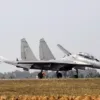
The Indian military was also able to detect Pakistan's preparations for attack and "opted for a quasi-immediate counterstrike", it said. The IAF struck Pakistan using BrahMos, SCALP-EG and Rampage missiles launched from within Indian airspace by Su-30MKIs, Jaguars and Rafales.
"The missiles struck seven sites up to 200 kilometres inside Pakistani territory, including one surface-to-air missile battery and five air bases. In north Pakistan, Nur Khan Air Base, near Islamabad, was hit by at least one missile, which destroyed a PAF command-and-control centre, while Murid Air Base, the hub of Pakistan’s MALE drone fleet, saw several hangars housing drones and a control centre struck," the report said.
"In central Pakistan, the small Rahim Yar Khan Air Base sustained several missile impacts on its runway, while the civilian airport terminal, which reportedly hosted a drone control centre, was also severely damaged. Rafiqi Air Base was also targeted, though the Indian side did not disclose specific objectives or damage inflicted. Finally, in the south, a hangar that housed drones and a radar at Sukkur Air Base were struck," it added.
About The Author










Comment List